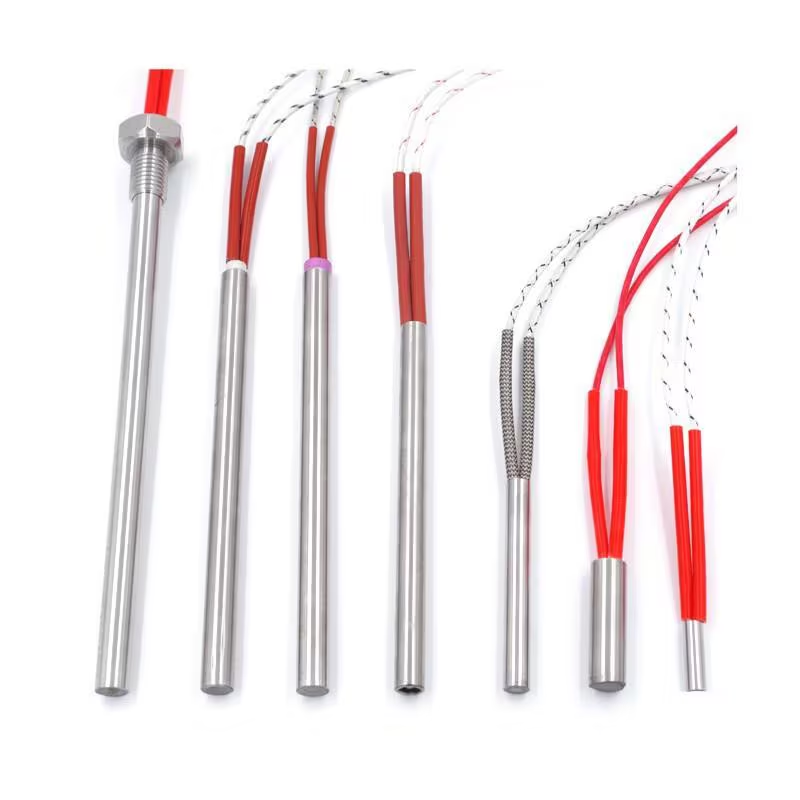
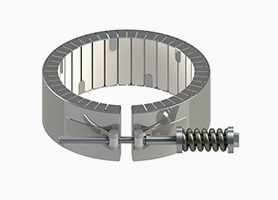
Cartridge heaters are cylindrical, high-performance industrial heating elements often categorized as component heaters. They are built with a coiled heating wire wound around a ceramic core and are designed for heavy-duty applications using Joule heating principles. When a two- or three-phase electrical supply is applied, the current heats the internal coil, which in turn raises the temperature of the surrounding sheath.
The watt density (W/in²) is influenced by the number of wire turns per inch, affecting how much heat is generated in a compact area. The outer sheath makes direct contact with the surface that requires heating, ensuring efficient thermal transfer. High-quality insulation inside the heater prevents the heating wire from touching the sheath, thereby increasing safety and preventing potential failures due to overheating.
To withstand elevated temperatures, the lead wires exiting the terminals are shielded with high-temperature-resistant materials such as silicone sleeves or metal conduits. Common lead wire materials include fiberglass and silicone rubber, offering durability in demanding environments.
Cartridge heaters are an excellent choice for delivering focused heat to solid metal parts, particularly where space is limited and an insert-type solution is preferred. The swaged design minimizes internal air pockets, leading to faster heat-up times, better heat transfer, and improved efficiency. The heater's compact build allows the heating elements to stay close to the sheath, maintaining a low internal core temperature and maximizing heat output at the contact surface.
Constructed with stainless steel sheaths, cartridge heaters resist oxidation and provide extended service life. They are manufactured to exact tolerances for a precise fit, which is crucial because performance is affected by how closely the heater fits in its mounting hole. Greater clearance reduces the allowable watt density and affects temperature control.
For accurate thermal management, thermocouples—either Type J or K—can be integrated within the heater. However, frequent ON/OFF cycling of power can reduce thermocouple lifespan. For best results and extended performance, using a PID controller with auto-tuning functionality and solid-state relays or thyristor outputs is recommended.
Key features
They deliver rapid, uniform heat with high thermal conductivity for precise temperature control.
Designed for easy integration into machinery, offering quick setup and minimal maintenance
Applications
Molds
Metal dies
Patens
hot plates
sealing tools
fluid heating
aerospace
semiconductor industry
screen exchangers
plastic extruders
Food service and medical equipment
Deionized water
Need Cartridge Heaters for your machine?
Send size, voltage, wattage and quantity – we will quote against your requirement.